
The Upanishadic Vision
The Upanishads, revered as the culmination of Vedic wisdom—Vedanta—do not merely outline philosophical doctrines; they serve as a direct cartography of human consciousness. In a modern era marked by fragmentation, digital distraction, and inner disquiet, the Upanishadic inquiry remains not an archaic intellectual relic, but an immediate practical necessity.
The word Upanishad carries deep etymological and practical significance: Upa (near), Ni (down), and Shad (to sit). It evokes the sacred atmosphere of an earnest seeker sitting closely at the feet of an illumined Guru to receive experiential wisdom. In our ancient Guru Parampara, transmitted through revered masters such as Yog Yogeshwar Mahaprabhu Ramlal Ji Bhagwan, wisdom is never purely scholastic. The Upanishads demand that truth be lived, internalized, and directly perceived.
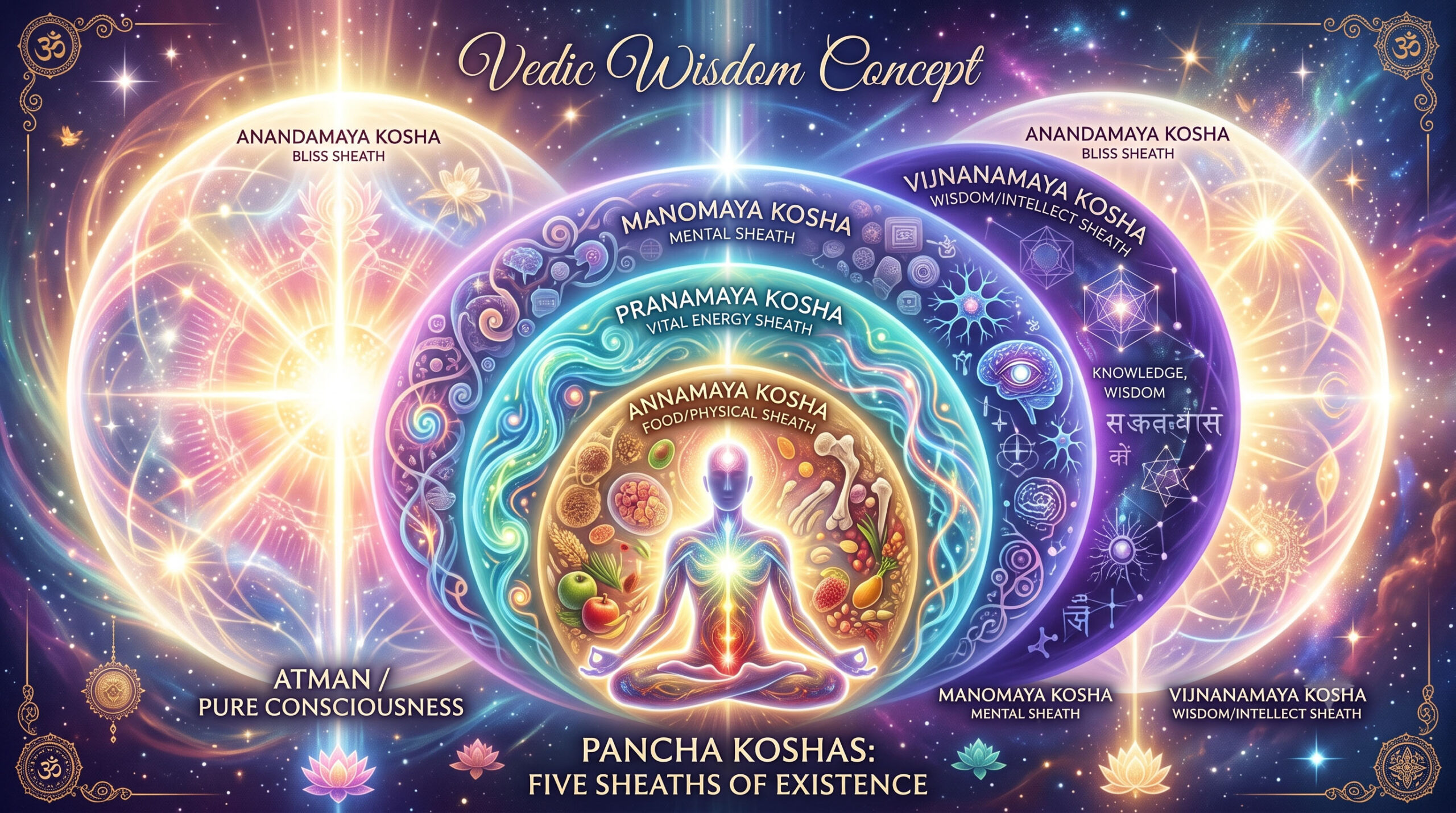
1. Beyond the Physical: The Journey Through the Pancha Koshas
A prevalent misunderstanding in contemporary discourse reduces spiritual science to external movement or mere physical wellness. The Taittiriya Upanishad systematically dismantles this limitation through the science of the five sheaths (Pancha Koshas):
- Annamaya Kosha (The Food/Physical Sheath)
- Pranamaya Kosha (The Vital Energy Sheath)
- Manomaya Kosha (The Mental Sheath)
- Vijnanamaya Kosha (The Wisdom/Intellect Sheath)
- Anandamaya Kosha (The Sheath of Pure Bliss)
Physical postures and bodily purification cultivate stability only in the outer courtyard of existence—the Annamaya Kosha. The Upanishads remind us that true evolution requires inward progression. As breath and vital force (Prana) harmonize through dedicated discipline, the turbulent oscillations of the Manomaya Kosha begin to dissolve. When the intellectual faculty (Vijnanamaya) surrenders its rigid ego-structures, the seeker abides effortlessly in the innermost sanctum of unconditioned joy (Anandamaya).
2. The Core Realization: Atman and Brahman
At the heart of the major Upanishads—from the concise verses of the Isha and Mandukya to the profound dialogues of the Katha and Chandogya—lies a single, luminous realization: the essential identity of the individual Self (Atman) and the Supreme Reality (Brahman).
In the Katha Upanishad, when the youthful seeker Nachiketa stands before Yama, he does not ask for worldly dominion, celestial longevity, or fleeting material pleasures. He asks for the secret of the Self that transcends mortality. Lord Yama imparts the foundational distinction between:
- Preya (that which is merely pleasant, comforting, and transient)
- Shreya (that which is intrinsically good, liberating, and eternal)
Spiritual evolution demands discernment (Viveka)—the clarity to turn away from the ephemeral sensory impulses of Preya and dedicate one\’s life to the enduring reality of Shreya. When the senses, which naturally stream outward into external forms, are drawn back into the heart space through inward focus (Pratyahara), the immortal light within begins to reveal itself.
3. The Chariot Allegory: Mastery of the Inner Mechanism
To make this inward journey tangible, the Katha Upanishad presents the timeless metaphor of the chariot:
| Symbol | Spiritual Faculty | Practical Role |
|---|---|---|
| The Chariot | Physical Body | The vehicle navigating earthly existence |
| The Passenger | Atman (True Self) | The silent, witnessing consciousness |
| The Charioteer | Buddhi (Intellect / Discernment) | The guiding faculty that must remain awake and aligned |
| The Reins | Manas (Mind) | The instrument of focus connecting intellect to senses |
| The Horses | Indriyas (Senses) | Powerful forces that must be directed, not indulged |
| The Road | Sense Objects / Life Paths | The external realm of interaction and duty |
If the charioteer (Buddhi) falls asleep or becomes weak, the reins (Mind) slacken, and the sensory horses drag the chariot off course into turmoil. Conversely, when the intellect is illumined through spiritual discipline and surrender to the Guru’s grace (Guru Kripa), the mind remains steady, the senses follow willingly, and the journey reaches its supreme destination: self-realization and freedom from fear.
4. The Four Great Declarations (Mahavakyas)
The essential truth of the Upanishadic canon is crystallized within the four great Vedic aphorisms:
- Prajnanam Brahma (Aitareya Upanishad, Rigveda) — \”Consciousness is Brahman.\”Awareness is not a byproduct of physiological processes; it is the fundamental fabric of existence.
- Tat Tvam Asi (Chandogya Upanishad, Samaveda) — \”Thou Art That.\”The individual essence within you is identical to the universal divine reality.
- Ayam Atma Brahma (Mandukya Upanishad, Atharvaveda) — \”This Self is Brahman.\”The observer of the waking, dreaming, and deep sleep states is none other than the transcendent absolute.
- Aham Brahmasmi (Brihadaranyaka Upanishad, Yajurveda) — \”I am Brahman.\”The culmination of non-dual realization, dissolving all false separations of \’self\’ and \’other\’.
5. Living the Upanishads in Modern Everyday Life
Spiritual philosophy is not meant for silent contemplation on mountain peaks alone; it must find expression in the marketplace, the household, and daily responsibilities. The very opening verse of the Isha Upanishad provides the definitive blueprint for modern living:
īśāvāsyamidaṃ sarvaṃ yatkiñca jagatyāṃ jagat
tena tyaktena bhuñjīthā mā gṛdhaḥ kasyasviddhanam
\”All this—whatever moves in this moving world—is pervaded by the Divine. Protect the Self through conscious renunciation; do not covet anyone\’s wealth.\”
To live this wisdom today means:
- Cultivating Inward Discipline: Establishing daily rhythms of silent contemplation and breath mastery to quiet nervous exhaustion and restore mental equilibrium.
- Transforming Action into Devotion: Viewing daily duties, family life, and professional service not as burdens, but as consecrated offerings (Seva).
- Practicing Detached Enjoyment: Engaging fully with the world with reverence, knowing that while we dwell in forms, our true nature remains formless and free.
When spiritual discipline is grounded in the lineage of the Guru and ignited by authentic inner practice, the teachings of the Upanishads cease to be words on ancient palm leaves. They become a living, breathing reality—awakening the practitioner from spiritual slumber into the radiant light of eternal truth.



Leave a Reply